MrWalls Drywall & Painting Western Massachusetts
Drywall installed over Popcorn ceilings In Western MA
Drywall installed over Popcorn ceilings In Western Massachusetts. Get rid of that outdated popcorn texture with drywall installed over the painted texture. Drywall lamination. enjoy new smooth ceilings today!
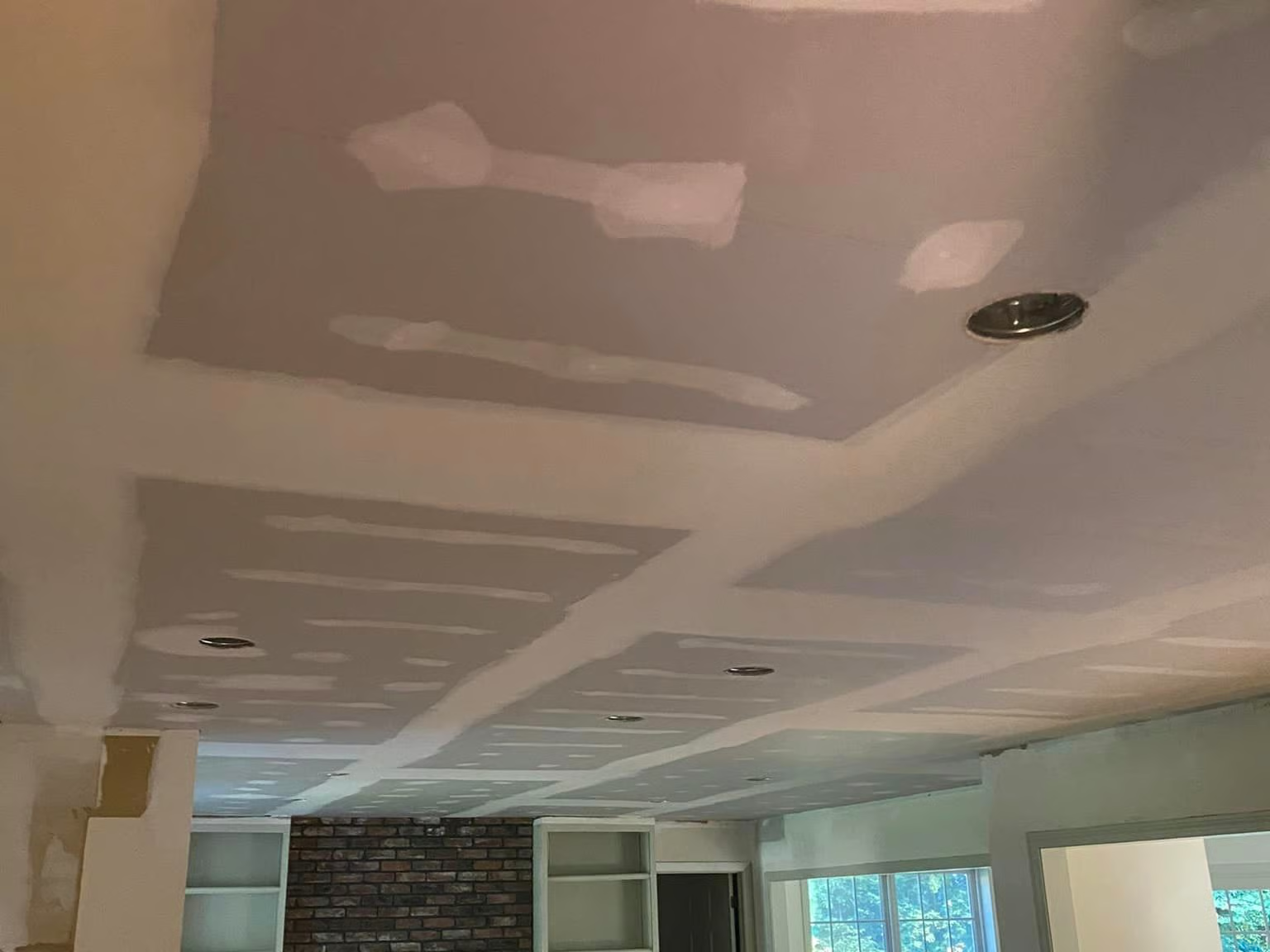
When a painted popcorn ceiling cannot be removed, hanging new drywall directly over it is the cleanest, most durable solution available. MrWalls installs drywall overlays on painted popcorn ceilings across the Pioneer Valley and finishes them to a smooth, modern standard.
Painted popcorn ceilings are one of the most common problems MrWalls is called to solve in Western Massachusetts homes. The texture was applied by the thousands of square feet across Springfield, Chicopee, Holyoke, Westfield, Agawam, Ludlow, and every other community in the Pioneer Valley during the 1960s through 1980s. And once that texture has been painted over once or twice, the options for dealing with it narrow considerably.
Wet scraping, the standard removal technique for unpainted popcorn, does not work well on painted ceilings. The paint seals the surface and prevents water penetration, making the texture difficult to soften and requiring aggressive scraping that damages the face paper of the drywall beneath. The result is a surface that needs extensive skim coat repair before it can be painted, often at a cost that approaches or exceeds the alternative. That alternative is hanging a new layer of drywall directly over the existing painted popcorn ceiling, taping and finishing it smooth, and producing a flat, modern surface in a single clean process.
MrWalls Drywall and Painting installs drywall overlaid onto painted popcorn ceilings throughout Western Massachusetts. We handle the complete project from assessment through finished, painted ceiling, giving homeowners the smooth surfaces they want without the mess, uncertainty, and damage risk of scraping painted texture.
Why Painted Popcorn Is Different from Unpainted Popcorn
Understanding why painted popcorn presents a different problem than unpainted popcorn helps homeowners make an informed decision about which removal method is right for their situation.
Unpainted popcorn texture is relatively easy to wet and scrape. Water penetrates the texture, softens the adhesive bond between the compound and the drywall face paper, and allows the texture to be cleanly scraped away with minimal damage to the substrate below. The underlying drywall emerges mostly intact, requiring modest skim coat repair before paint.
Painted popcorn is a different material. The paint film acts as a moisture barrier, preventing water from penetrating to the adhesive layer beneath. Scraping requires much greater force, tears the texture off in chunks rather than sheets, and frequently removes the face paper along with it. The resulting surface is rough, porous, and inconsistent, requiring extensive skim coat work that significantly increases the total popcorn removal cost. For ceilings painted more than once, the damage to the substrate is almost always severe enough that overlaying new drywall is faster, cleaner, and more economical than attempting wet removal.
The Three Options for Painted Popcorn Ceilings
When removing painted popcorn ceiling in a Western Massachusetts home, homeowners have three viable approaches. MrWalls presents all three honestly and recommends based on the specific ceiling, the home, and the homeowner's priorities.
Popcorn Removal and Skim
- No ceiling height loss.
- High risk of face paper damage.
- Extensive skim coat repair needed.
- Messy, labor-intensive process.
- Often costs more than overlay.
- Asbestos risk still applies pre-1980.
Drywall Overlay
- Clean, predictable result.
- Loses approximately half an inch of height.
- Encapsulates painted surface safely.
- No asbestos disturbance if positive test.
- Smooth finish over the entire ceiling.
- Often most cost-effective option.
Leave It and Repaint
- No construction involved.
- Texture remains visible and dated.
- Damage and stains still show through.
- Does not resolve the underlying problem.
- Least costly short term only.
- Not a long-term solution.
The Asbestos Factor in Pre-1980 Western Massachusetts Homes
Popcorn texture applied before 1980 in Western Massachusetts homes may contain asbestos. This is a well-documented reality across the Pioneer Valley's housing stock and it is not a risk to ignore. When an asbestos test on a popcorn ceiling returns a positive result, wet removal is not an option without licensed abatement. Dry scraping disturbs the material in a way that also requires abatement under Massachusetts regulations. The overlay approach changes the equation entirely.
Hanging new drywall over asbestos-positive popcorn texture does not disturb the existing material. The new drywall encapsulates the texture in place, covering it completely with a permanent layer of new material. This is a recognized and accepted approach for managing in-place asbestos-containing materials when the surface is not damaged and does not need to be removed for structural or other reasons. It is usually the cleanest and most cost-effective solution for asbestos-positive painted popcorn ceilings in Western MA homes.
What the Drywall Overlay Process Involves
Installing drywall over a painted popcorn ceiling is not simply screwing sheets to the existing surface. Done correctly, it requires locating the existing framing accurately, fastening at sufficient intervals and into solid material, managing the added load on the structure, addressing transitions at walls and light fixtures, and finishing to the same standard as any other drywall installation. MrWalls follows a deliberate sequence on every overlay project.
- 1Structural assessment. Before any material is ordered or installed, we assess whether the existing ceiling structure can support the added weight of a new drywall layer. Standard half-inch drywall adds approximately two pounds per square foot of ceiling area. In most Western Massachusetts homes with standard joist spacing, this is well within structural tolerance. In older homes with unusual framing, compromised joists, or atypical construction, we confirm suitability before proceeding.
- 2Joist location and marking. The existing ceiling joists are located precisely using a stud finder, marked at both edges of the room, and snapped in chalk lines across the full ceiling span. Every fastener in the overlay must hit solid framing, not just the existing drywall. Fasteners that miss framing and land only in the existing ceiling will not support the new panel and will fail over time.
- 3Electrical and fixture coordination. All existing ceiling fixtures, fan boxes, smoke detectors, and access panels are identified before hanging begins.
- 4Panel layout and cutting. Sheets are laid out to minimize butt joints in high-visibility areas of the ceiling and to position seams away from the center of the room where possible. Panels are cut to size on the ground before being lifted. Precise cutting at this stage reduces time overhead and produces cleaner edges at walls and perimeter details.
- 5Installation into framing. New drywall panels are lifted and fastened directly into the ceiling joists using screws long enough to penetrate through the existing drywall and into the framing 3/4" beyond it. Standard drywall screws used for new construction are not long enough for an overlay application. MrWalls uses the correct fastener length for the specific combination of existing ceiling thickness and new panel thickness on every overlay project.
- 6Perimeter and transition management. Where the new ceiling meets existing walls the drywall is taped. Crown molding, or cove molding also may conceals this transition.
- 7Taping and finishing. All seams and fasteners are taped and finished in multiple coats of joint compound, feathered to the specified finish level. For most residential overlay projects, Level 4 finish is appropriate. For rooms planned for satin or semi-gloss paint, Level 5 skim coat is applied over the entire surface before priming.
- 8Sanding under raking light. Fully cured compound is sanded smooth and inspected under a raking work light before any primer is applied. Any remaining ridges, trowel marks, or surface inconsistencies are addressed at this stage.
- 9Prime and paint-ready finish. The finished ceiling is primed with the appropriate product for new drywall and left ready for paint. MrWalls can complete the painting as well, delivering a finished ceiling in a single project engagement from the first sheet of drywall through the final coat of paint.
How Much Ceiling Height Is Lost
The most common concern homeowners raise about the drywall overlay approach is the loss of ceiling height. It is a legitimate consideration, and MrWalls addresses it directly rather than minimizing it.
Standard half-inch drywall adds approximately half an inch of thickness to the ceiling, measured from the face of the existing popcorn texture to the face of the new drywall. In a room with eight-foot ceilings, this brings the finished ceiling height to approximately seven feet eleven and a half inches. In most rooms this difference is imperceptible without measuring. In rooms with already-low ceilings, or in spaces where ceiling height is architecturally significant, it is worth discussing during the estimate walkthrough. Quarter-inch drywall panels are available for overlay applications where minimizing height loss is a priority, though they require more care in handling and finishing.
Ceiling Fans, Recessed Lights, and Other Fixtures
One of the practical details that affects overlay projects is the treatment of existing ceiling fixtures. Every electrical box in the existing ceiling needs to be cutout and sometimes longer screws are used to remount the lights.
For recessed light fixtures, the process varies by fixture type. Some recessed cans have adjustable trim rings that can be lowered to accommodate the added ceiling thickness. MrWalls identifies the fixture types in every room during the pre-project walkthrough and provides guidance on what adjustments are needed before work begins, so there are no surprises when the new ceiling is in place.
MrWalls tip: if a ceiling overlay project coincides with a lighting upgrade, this is an ideal time to replace older recessed fixtures with LED wafer lights or new-construction cans. Wafer lights in particular have a very low profile and are designed to install into finished ceilings without a housing can, making them an excellent and cost-effective complement to an overlay project.
Drywall Over Popcorn vs. Popcorn Removal and Skim Coat
For homeowners weighing the overlay approach against popcorn removal and skim coat, the decision generally comes down to four factors: whether the texture is painted, whether asbestos is present or suspected, the condition of the existing drywall beneath the texture, and total project cost.
On unpainted popcorn ceilings with no asbestos concern and good substrate condition beneath, removal and skim coat is a perfectly viable and often slightly lower-cost approach. On painted ceilings, on ceilings with positive or suspected asbestos, on ceilings where the underlying drywall is old or in poor condition, or on ceilings where extensive prior patching has left an inconsistent substrate, the overlay approach typically produces a better result at equal or lower total cost. MrWalls prices both approaches for homeowners who want to compare before committing.
Why MrWalls for Drywall Over Painted Popcorn in Western Massachusetts
MrWalls Drywall and Painting has installed drywall over popcorn ceilings across Springfield, Chicopee, Holyoke, Westfield, Northampton, Agawam, Ludlow, Wilbraham, Longmeadow, East Longmeadow, and throughout the Pioneer Valley. We know the housing stock, the joist systems, and the fixture types found in Western Massachusetts homes of every era, and we bring that knowledge to every overlay project.
- Correct fastener length specified for every overlay, penetrating through existing material and into framing for a secure, lasting installation.
- Asbestos-aware practice, overlay approach recommended where disturbance of existing material is a concern in pre-1980 Pioneer Valley homes.
- Fixture and box extension coordination handled, no surprises when covers and canopies need to align with the new ceiling surface.
- Full finish capability, Level 4 or Level 5 skim coat, texture, prime, and paint all available through MrWalls in one project.
- Honest comparison of all three options, dry scrape, overlay, and repaint, so homeowners choose based on complete information rather than a contractor's preferred scope.
- Licensed, insured, and locally owned, a Pioneer Valley contractor with a reputation built on results that hold up under inspection and over time.
Frequently Asked Questions
Can drywall be hung over popcorn texture on any ceiling?
In most Western Massachusetts homes with standard framing and joist spacing, yes. The structural assessment conducted at the start of every overlay project confirms that the existing framing can support the added weight before any material is ordered. In homes with compromised joists, unusual framing, or atypical construction, additional reinforcement may be needed or an alternative approach recommended.
How much does drywall over popcorn cost compared to removal?
On painted ceilings, the overlay approach is often comparable in cost to dry scrape removal and typically less expensive than the dry scrape plus full skim coat that the damaged substrate requires afterward. The exact comparison depends on ceiling area, existing substrate condition, and finish level specified. MrWalls prices both options during the estimate walkthrough so homeowners can make a direct comparison.
Will the new ceiling need to be the same texture as the rest of the room?
The new drywall overlay produces a completely fresh surface that can receive any finish the homeowner specifies, smooth Level 5, knockdown, orange peel, or any other texture. Most homeowners take the overlay as an opportunity to move to a smooth or knockdown finish, leaving the dated popcorn look entirely behind. The new ceiling finish does not need to match the original popcorn texture in any way.
What happens to crown molding and trim when the ceiling is lowered?
Half an inch of ceiling height change does not typically require adjustment to crown molding or casing profiles. The new drywall is installed to within the standard perimeter gap of the wall surface, and the existing crown molding covers the transition in most cases. Where crown is very narrow or tightly fitted, minor adjustment may be needed. MrWalls identifies these conditions during the pre-project walkthrough and discusses the approach before work begins.
Can MrWalls paint the new ceiling after it is finished?
Yes. MrWalls Drywall and Painting handles the complete project from new drywall installation through primed and painted finished ceiling. We prime with the appropriate product for new drywall and apply two coats of your chosen ceiling paint, leaving the room completely finished. Completing both the drywall work and the painting through MrWalls eliminates the coordination between trades and ensures the primer and paint system is correct for the substrate we produced.
Serving Western Massachusetts Communities
MrWalls provides drywall and skim coating over painted popcorn ceiling services throughout Western Massachusetts, including Springfield, Chicopee, Holyoke, Westfield, Northampton, Easthampton, Agawam, Ludlow, Wilbraham, East Longmeadow, Longmeadow, South Hadley, Amherst, Belchertown, Palmer, Ware, and surrounding communities across Hampden and Hampshire Counties. Whether you have one room with a damaged painted popcorn ceiling or an entire house that needs to be updated, MrWalls delivers the same quality of installation and finish on every project.
Painted Popcorn Ceiling Holding You Back?
MrWalls installs drywall over painted popcorn ceilings across Western Massachusetts, producing a smooth, modern finish without the mess and risk of scraping painted texture.
Call or email us today: (413) 302-0640 · [email protected]
Call To Request a Free Estimate ↗